Showing posts with label taxes. Show all posts
Wednesday, October 12, 2011
Alabama's Attorney General makes claims about "Illegal Aliens"
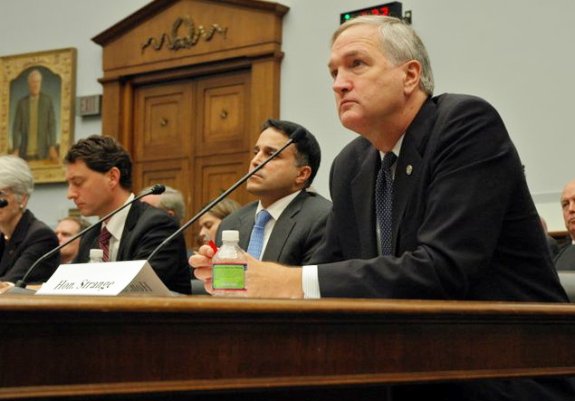
Alabama Attorney General, Luther Strange, testifying before Congress. Photo by lutherstrange.
Excerpts from the Immigration Impact by Wendy Sefsaf
Oct 12, 2011
CLAIM: Yesterday, Alabama’s Attorney General claimed that “illegal aliens” make up a substantial portion of the state’s prison population.
FACT: Alabama's prison population: 31,000 -- 182 of which are currently subject to deportation based on holds placed by U.S. Immigration and Customs Enforcement. That is about 1/2 of one percent.
CLAIM: Yesterday, Alabama’s Attorney General claimed “many of these people are taking jobs away from United States citizens."
FACT: Alabamas unemployment rate hovers around 10%. To say that one undocumented worker fired is one documented worker hired might be politically expedient, but the research actually shows just the opposite. Undocumented workers tend to have different skills, education, and experience levels than native-born workers. In fact, if a 1 to 1 worker replacement was the answer, why is the Governor considering using the prison population to alleviate a severe worker shortage on Alabama farms? Where are all those unemployed Americans waiting to work in the fields?
CLAIM: The Alabama’s Attorney General claims there are "difficulties in collecting taxes from these persons ["illegal aliens"], many of whom work off the books, means that many of them are utilizing Alabama’s public resources without paying their fair share.”
FACT: According to the Institute on Tax and Economic Policy, undocumented immigrants in Alabama pay $25 million in income taxes, $5.8 million in property taxes, and $98 million in sales taxes, for a total contribution of more than $130 million.
The actual costs to Alabama’s economy have yet to be determined, and no real estimates have been provided by the lawmakers behind HB56. It has always been the case that estimating the costs and contributions of unauthorized immigrants is not an exact science. But Alabama is about to make it a bit easier. No longer will losing your undocumented population be an abstract proposition. In Alabama it’s about to be a reality, and with it the economic ramifications of a mass exodus of workers, consumers, and taxpayers from an already struggling state economy.
See more from the source: http://immigrationimpact.com/2011/10/12/the-facts-and-numbers-don%e2%80%99t-matter-in-alabama/
Labels:
Alabama,
alien,
border patrol,
employment,
illegal immigrants,
Immigration law,
latino,
law,
leyes,
migratorio,
nueva ley de inmigracion,
sin papel,
taxes,
undocumented
Friday, September 9, 2011
California: financiación a estudiantes indocumentados pendiente de una firma
Tal vez los estudiantes sin papeles en California puedan tomar clases a la universidad sin pagar los cargos del los de otros estados. Les falta una firma este proyecto.
Artículo de BBC Mundo:
http://www.bbc.co.uk/mundo/noticias/2011/09/110908_california_dream_act_en.shtml
Artículo de BBC Mundo:
Lea más:Es época de regreso a clases y los estudiantes hispanos del estado de California tienen una razón para empezar el año con optimismo renovado.Desde hace unos días, la legislatura estatal aprobó su propio clic Dream Act, una ley que allanará el camino a miles de indocumentados que quieren continuar con su educación después de la secundaria en esa región estadounidense.
La norma es, en realidad, un paquete de medidas presentadas por el representante demócrata Gil Cedillo para proveer financiación universitaria a jóvenes sin papeles, muchos de ellos traídos a Estados Unidos de pequeños por sus padres.Contenido relacionado
En dos partes, el proyecto recibió el visto bueno del Congreso estatal: la AB130, que entrará en vigor en 2012, permite solicitar fondos privados o préstamos; luego, la AB131 da un paso más allá y daría acceso a los indocumentados a becas y subsidios de tipo estatal, casi en pie de igualdad con los residentes legales de California.
Aprobada el viernes pasado, la segunda porción del llamado Dream Act californiano está a la espera de la firma del gobernador Jerry Brown.
Estudiantes y activistas celebraron la medida como un paso adelante en la larga batalla por conseguir mejoras educativas para indocumentados. El Dream Act federal -un acrónimo que identifica a la Ley para el Desarrollo, Alivio y Educación para Menores Extranjeros- permitiría acceder para la residencia legal a aquellos estudiantes que cumplan con ciertos requisitos, pero lleva diez años esperando convertirse en ley.
Así, estados como California o Illinois -donde se probó una norma parecida a la AB130 este verano- han decidido avanzar por su cuenta, sin esperar una reforma a escala nacional. Aunque, a diferencia del criticado Dream Act federal, las normas estatales plantean ayudas económicas pero no ofrecen un camino a la ciudadanía.
Firma pendiente
Las estadísticas oficiales señalan que más de 65% de los universitarios estadounidenses recibe alguna forma de ayuda financiera para completar la carrera. Los extranjeros sin permiso de residencia, en tanto, no son elegibles para asistencia federal o estatal.
La firma de la AB131 podría cambiar eso y ahora las miradas están puestas en el gobernador Brown.
"Le pedimos al gobernador Brown que encienda la antorcha de oportunidades para estos estudiantes", expresó Angélica Salas, directora de la Coalición por los Derechos Humanos de los Inmigrantes de Los Ángeles (CHIRLA, en inglés).
Pero Brown no la tiene fácil: aunque, por principio, el demócrata defiende la propuesta y su firma le sumaría apoyos entre los hispanos, tiene sobre sí el fantasma de la economía estatal, con un déficit de US$26 mil millones.
"Hay incertidumbre por una cuestión que es meramente financiera: el presupuesto es muy ajustado y hay muchos que dicen que el estado no puede hacerse cargo de proveer ayudas económicas para más gente de la que ya tiene", señaló a BBC Mundo John Pitney, experto en política californiana del Claremont McKenna College.
La primera parte (AB130), rubricada por Brown el pasado agosto, no generó tanta oposición porque legisla sobre el acceso a fondos privados. Ahora, los que rechazan la medida se han valido de los números para pedir el veto del gobernador a la segunda porción del Dream Act estatal."Le pedimos al gobernador Brown que encienda la antorcha de oportunidades para estos estudiantes"Angélica Salas, directora de CHIRLA
El congresista californiano Tim Donnelly, por ejemplo, lleva adelante una campaña desde su página web.
"Los analistas estiman el costo (de dar acceso a los estudiantes indocumentados a subsidios estatales) en decenas de millones al año… al tiempo que la promesa de educación barata y de alta calidad atraerá cada vez más inmigración ilegal", señaló el republicano.
Mejor futuro
En tanto, quienes defienden la norma también apelan a los números: la economía del país necesitará el día de mañana de latinos con capacitación universitaria y los hispanos representan, al fin de cuentas, 12,5% de los inscritos en la educación superior.
http://www.bbc.co.uk/mundo/noticias/2011/09/110908_california_dream_act_en.shtml
Thursday, August 25, 2011
The economic effect of deportation and expulsion of immigrants
Is this what is best for your town? Will you still be able to pay your mortgage if all the immigrants in your community leave, or are forced out? Often, those who oppose immigrants claim that the foreigners are taking away our jobs. However, the evidence does not support this view. This video shows just one town's realization after trying to exclude immigrants, that they play a vital role in our society and that we need their contribution. Click to view it.
Monday, August 8, 2011
Telling the New American Dreamers - "Go Elsewhere !"
By JENNIFER EPSTEIN | 6/15/11 8:02 AM EDT Updated: 6/15/11 4:18 PM EDT
In a major speech to the Council on Foreign Relations on Wednesday, New York City Mayor Michael Bloomberg says the United States risks “national suicide” if it doesn’t adopt a more welcoming immigration policy.
“We will not remain a global superpower if we continue to close our doors to people who want to come here to work hard, start businesses, and pursue the American dream,” Bloomberg said.
"The American dream cannot survive if we keep telling the dreamers to go elsewhere,” the mayor adds. “It’s what I call national suicide – and that’s not hyperbole.”Immigration reform, he argues, is the key to creating new jobs and setting the economy on a steady path into the future.
Bloomberg’s speech comes as the Partnership for a New American Economy, of which he is a co-chair, releases a report looking at the role that immigrants play at Fortune 500 companies and the potential. Forty percent of Fortune 500 companies were founded by immigrants or the children of immigrants, the report notes.
Labels:
America,
assimilation,
business,
citizenship,
Dream,
E-Verify,
economy,
employer,
foreign,
ICE,
illegal immigrants,
inmigracion,
jobs,
migrants,
nueva ley de inmigracion,
taxes,
undocumented
Monday, June 20, 2011
Irish Immigrants: Send them HOME !
They are stealing our jobs. They aren't paying any taxes. They are a drain on our society. They are having babies so they can claim social services and stay in our country. They don't speak our language. Send them HOME !
Irish Immigrants 1860s
In 1845, the great
potato rot touched off a mass migration. The disaster eliminated the sole subsistence of millions of peasants, thrusting them over the edge of starvation. For five weary years, the crops remained undependable, and famine swept through the land. Untold thousands perished, and the survivors, destitute of hope, wished only to get away (Handlin, 1972).

The only mode of escape was emigration. Starving families that could not pay landlords faced no alternative but to leave the country in hopes of a better future. And thus the steadily scaling number of Irish who entered the U.S. between 1820 and 1830 skyrocketed in the 1840s, nearly 2 million came in that decade. The flow persisted increasingly for another five years, as the first immigrants began to earn the means of sending for relatives and friends. The decade after 1855 showed a subside in the movement, but smaller numbers continued to arrive after the Civil War. Altogether, almost 3.5 million Irishmen entered the U.S. between 1820 and 1880.
Emigrating to the U.S. wasn't the magical solution for most of the immigrants. Peasants arrived without resources, or capital to start farms or businesses. Few of them ever accumulated the resources to make any meaningful choice about their way of life. Fortunately for them, the expansion of the American economy created heavy demands for muscle grunt. The great canals, which were the first links in the national transportation system were still being dug in the 1820s and 1830s, and in the time between 1830 and 1880, thousands of miles of rail were being laid. With no bulldozers existing at the time, the pick and the shovel were the only earth-moving equipment at the time. And the Irish laborers were the mainstay of the construction gangs that did this grueling work. In towns along the sites of work, groups of Irish formed their small communities to live in.
More than 2.6 million Irish came in the decades after 1860.
Source:
http://library.thinkquest.org/20619/Irish.html
Irish Immigrants 1860s
In 1845, the great
The only mode of escape was emigration. Starving families that could not pay landlords faced no alternative but to leave the country in hopes of a better future. And thus the steadily scaling number of Irish who entered the U.S. between 1820 and 1830 skyrocketed in the 1840s, nearly 2 million came in that decade. The flow persisted increasingly for another five years, as the first immigrants began to earn the means of sending for relatives and friends. The decade after 1855 showed a subside in the movement, but smaller numbers continued to arrive after the Civil War. Altogether, almost 3.5 million Irishmen entered the U.S. between 1820 and 1880.
Emigrating to the U.S. wasn't the magical solution for most of the immigrants. Peasants arrived without resources, or capital to start farms or businesses. Few of them ever accumulated the resources to make any meaningful choice about their way of life. Fortunately for them, the expansion of the American economy created heavy demands for muscle grunt. The great canals, which were the first links in the national transportation system were still being dug in the 1820s and 1830s, and in the time between 1830 and 1880, thousands of miles of rail were being laid. With no bulldozers existing at the time, the pick and the shovel were the only earth-moving equipment at the time. And the Irish laborers were the mainstay of the construction gangs that did this grueling work. In towns along the sites of work, groups of Irish formed their small communities to live in.
More than 2.6 million Irish came in the decades after 1860.
Source:
http://library.thinkquest.org/20619/Irish.html
Labels:
agriculture,
alien,
American way,
assimilation,
citizenship,
comprehensive,
Europe,
illegal immigrants,
immigation,
Ireland,
Irish,
taxes
Thursday, June 16, 2011
Send them HOME !
They are stealing our jobs. They aren't paying any taxes. They are a drain on our society. They are having babies so they can claim social services and stay in our country. They don't speak our language. Send them HOME !
Send us your huddled masses.
Irish immigrants a century ago.
Send us your huddled masses.
Irish immigrants a century ago.
Labels:
alien,
border,
detention center,
E-Verify,
economy,
education,
employers,
hispanic,
illegal immigrants,
mexicans,
migrants,
security,
social service,
taxes,
undocumented
Wednesday, June 8, 2011
Maria Gonzales: illegal alien. What will you do with her?
You have a choice. What will you do?
1. Report Maria and her boss to the authorities, so Maria will be deported.
2. Keep quiet, do nothing and allow Maria to continue supporting her family even though she arrived here illegally and her boss illegally hired her.
3. Try to find a way for Maria to become legalized and for her boss to pay all her taxes.
Labels:
alien,
Arizona,
benefits,
business,
Dream,
employers,
hispanic,
illegal immigrants,
immigration reform,
IRS,
jobs,
law,
medicare,
mexicans,
social service,
taxes,
undocumented,
unemployment,
welfare
Monday, June 6, 2011
Los Angeles faces welfare costs for immigrants
Children of illegal aliens cost county welfare $44 million in March
Source: Office of Supervisor Michael D. Antonovich, Los Angeles County Board of Supervisors, 5th District
LOS ANGELES COUNTY - Figures from the Department of Public Social Services show that children of illegal aliens in Los Angeles County collected more than $21 million in welfare and more than $22 million in food stamps in March 2009 -- an increase of $1 million from the previous month, according to a news release from Los Angeles County Supervisor Michael D. Antonovich.Annually the cost of illegal immigration to Los Angeles County taxpayers exceeds one billion dollars, which includes $220 million for public safety, $400 million for healthcare, and $500 million in welfare and food stamps allocations, according to the news release.
Twenty-four percent of the county's total allotment of welfare and food stamp benefits goes directly to the children of illegal aliens born in the United States, according to Antonovich's statement.
"Illegal immigration continues to have a devastating impact on Los Angeles County taxpayers," Antonovich said in the statement. "The total cost for illegal immigrants to county taxpayers exceeds $1 billion a year - not including the millions of dollars for education."Click to see more of this article:
The Signal.Com
Sunday, May 29, 2011
Undocumented Immigrants: a burden or benefit?
Myth: Undocumented workers are a burden on the U.S. economy.
Reality: Immigrants not only pay taxes, but they also contribute significantly to the economy.In a 2007 report, the White House Council of Economic Advisers concluded that..
-. Immigration increases the U.S. Gross Domestic Product (GDP) by roughly US $37 billion each year.
- Given that employment has been the main driver behind undocumented immigration to the U.S. in recent decades, it should come as no surprise that this group is particularly hard working and has a high employment rate (96%).
According to the U.S. Department of Commerce and the U.S. Census Bureau, Hispanic owned firms increased by nearly 44 percent between 2002 and 2007, growing from 1.6 million businesses to 2.3 million.
Employment at Hispanic-owned firms also grew by 26 percent from 1.5 million to 1.9 million workers, a growth rate significantly higher than that of non-minority-owned firms.
Hispanic-owned businesses generated US$ 345.2 billion in sales in 2007, up 55.5 percent compared with 2002.
Read more: http://www.miamiherald.com/2011/05/25/2233839/sc-house-approves-immigration.html#comment#ixzz1Nkjydl6z
Labels:
border,
business,
congress,
economy,
employment,
hispanic,
illegal immigrants,
immigration reform,
jobs,
payroll,
social service,
taxes
Saturday, May 28, 2011
Who pays taxes?
My The U.S. Social Security Administration has estimated that three quarters of undocumented immigrants pay payroll taxes, and that they contribute US $6-7 billion in Social Security funds that they will be unable to claim (Porter 2005......, and an additional US$1.5 billion in Medicare taxes. This money, according to the 2008 annual report of the Social Security Board of Trustees, will help reduce the SSA’s projected longterm
deficit by 15%.
See more of this comment:Read more: http://www.miamiherald.com/2011/05/25/2233839/sc-house-approves-immigration.html#comment#ixzz1NgkZWmr3
deficit by 15%.
See more of this comment:Read more: http://www.miamiherald.com/2011/05/25/2233839/sc-house-approves-immigration.html#comment#ixzz1NgkZWmr3
Labels:
economy,
illegal immigrants,
immigration reform,
IRS,
job loss,
jobs,
medicare,
mexicans,
outsourcing,
payroll,
Property tax,
Social Security,
taxes,
undocumented,
unemployment
Wednesday, May 25, 2011
Free Services for Undocumented Immigrants?
Immigrants pay $ 80,000 more in taxes than they receive from the gov.
Source: Comments in the Miami Herald blog by commentor "Archie Bunker"
Myth: Undocumented immigrants are getting government services for free.
REALITY: They actually give more than they take. Over the past two decades, most studies that have tried to estimate the fiscal impact of immigration in the United States have concluded that the tax revenue generated by immigrants —both legal and undocumented— exceeds the cost of the services they use. Thus, an Economic Report of the President published in 2005 estimated that immigrants paid on average US $80,000 per capita more in taxes than the cost of the government services they were expected to use over their lifetime.
Stephen C. Goss, the chief actuary of the Social Security Administration, said that by 2007, the Social Security trust fund had received a net benefit of somewhere between US $120 billion and US $240 billion from undocumented immigrants. That represented 5.4% to 10.7% of the trust fund’s total assets of US$2.24 trillion that year. The Social Security Administration estimates that two-thirds of unauthorized immigrant workers (about 5.6 million people) were paying into the system in 2007. Unauthorized immigrants paid a net contribution of US$12 billion in 2007 alone.
Click to read more of this comment: http://www.miamiherald.com/2011/05/25/2233839/sc-house-approves-immigration.html#comment#ixzz1NNYck1tc
Source: Comments in the Miami Herald blog by commentor "Archie Bunker"
Myth: Undocumented immigrants are getting government services for free.
REALITY: They actually give more than they take. Over the past two decades, most studies that have tried to estimate the fiscal impact of immigration in the United States have concluded that the tax revenue generated by immigrants —both legal and undocumented— exceeds the cost of the services they use. Thus, an Economic Report of the President published in 2005 estimated that immigrants paid on average US $80,000 per capita more in taxes than the cost of the government services they were expected to use over their lifetime.
Stephen C. Goss, the chief actuary of the Social Security Administration, said that by 2007, the Social Security trust fund had received a net benefit of somewhere between US $120 billion and US $240 billion from undocumented immigrants. That represented 5.4% to 10.7% of the trust fund’s total assets of US$2.24 trillion that year. The Social Security Administration estimates that two-thirds of unauthorized immigrant workers (about 5.6 million people) were paying into the system in 2007. Unauthorized immigrants paid a net contribution of US$12 billion in 2007 alone.
Click to read more of this comment: http://www.miamiherald.com/2011/05/25/2233839/sc-house-approves-immigration.html#comment#ixzz1NNYck1tc
Labels:
economy,
employment,
illegal immigrants,
jobs,
mexicans,
payroll,
Social Security,
taxes,
undocumented,
unemployment
Tuesday, May 24, 2011
Economic, Demographic, and Fiscal Effects of Immigration
The New Americans: Economic, Demographic, and Fiscal Effects of Immigration
The New Americans: Economic, Demographic, and Fiscal Effects of Immigration is a 1997 study on the demographic, economic, and fiscal consequences of immigration to the United States by the National Research Council (NRC) of the National Academy of Sciences The NRC report found that although immigrants, especially those from Latin America, were a net cost in terms of taxes paid versus social services received, overall immigration was a net economic gain due to an increase in pay for higher-skilled workers, lower prices for goods and services produced by immigrant labor, and more efficiency and lower wages for some owners of capital. The report also notes that although immigrant workers compete with domestic workers for some low skilled jobs, some immigrants specialize in activities that otherwise would not exist in an area, and thus are performing services that otherwise would not exist, and thus can be beneficial for all domestic residents. The U.S. Census Bureau's Survey of Business Owners: Hispanic-Owned Firms: 2002 indicated that the number of Hispanic-owned businesses in the United States grew to nearly 1.6 million in 2002. Those Hispanic-owned businesses generated about $222 billion in revenue.[3] The report notes that the burden of poor immigrants is not born equally among states, and is most heavy in California.[4]
On the poor end of the spectrum, the "New Americans" report found that low-skill low wage immigration does not, on aggregate, lower the wages of most domestic workers.
Click to see more of this article from Wikipedia
On the poor end of the spectrum, the "New Americans" report found that low-skill low wage immigration does not, on aggregate, lower the wages of most domestic workers.
Click to see more of this article from Wikipedia
Labels:
business,
employment,
hispanic,
immigration reform,
jobs,
latin,
medicare,
mexicans,
Mexico,
migrants,
payroll,
social service,
taxes,
undocumented
Sunday, May 22, 2011
Illegal immigration and drug cartels
Are the Mexican drug cartels more effective at stopping illegal immigration than our own Border Patrol? Immigrants seeking to illegally enter the U.S. from Central America are faced with a new and growing threat, cartels. The question is: What does this say about the cartels?
In August, an Ecuadorian immigrant venturing to the U.S. was detained by the Zetas — a notorious Mexican drug cartel — with a group of 72 other immigrants containing both men and women. Due to their unwillingness to work for the cartel, all were shot dead while the one escaped.
There are two ways this can be viewed: Either the cartels are growing bigger, so they need more people to smuggle drugs into the U.S. — and there is no better way than to use those who are successful at getting in — or the cartels are weakening and have no choice but to coerce illegal immigrants to do their bidding.
I might have to go with the latter. When cartels are not generating high drug revenues from their core business, they tend to resort to other illegal activities, such as prostitution and people-smuggling.
Click to see more of this article. Source: The Hill's Pundit's Blog
Add a COMMMENT
In August, an Ecuadorian immigrant venturing to the U.S. was detained by the Zetas — a notorious Mexican drug cartel — with a group of 72 other immigrants containing both men and women. Due to their unwillingness to work for the cartel, all were shot dead while the one escaped.
There are two ways this can be viewed: Either the cartels are growing bigger, so they need more people to smuggle drugs into the U.S. — and there is no better way than to use those who are successful at getting in — or the cartels are weakening and have no choice but to coerce illegal immigrants to do their bidding.
I might have to go with the latter. When cartels are not generating high drug revenues from their core business, they tend to resort to other illegal activities, such as prostitution and people-smuggling.
Click to see more of this article. Source: The Hill's Pundit's Blog
Add a COMMMENT
Labels:
Arizona,
border,
business,
cartel,
detention center,
drug,
economy,
hispanic,
illegal immigrants,
latino,
Mexico,
migrants,
taxes,
undocumented,
Zeta
Subscribe to:
Posts (Atom)
