Showing posts with label migratorio. Show all posts
Wednesday, October 12, 2011
Alabama's Attorney General makes claims about "Illegal Aliens"
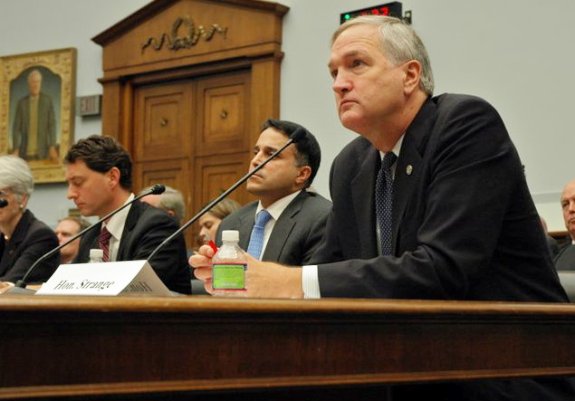
Alabama Attorney General, Luther Strange, testifying before Congress. Photo by lutherstrange.
Excerpts from the Immigration Impact by Wendy Sefsaf
Oct 12, 2011
CLAIM: Yesterday, Alabama’s Attorney General claimed that “illegal aliens” make up a substantial portion of the state’s prison population.
FACT: Alabama's prison population: 31,000 -- 182 of which are currently subject to deportation based on holds placed by U.S. Immigration and Customs Enforcement. That is about 1/2 of one percent.
CLAIM: Yesterday, Alabama’s Attorney General claimed “many of these people are taking jobs away from United States citizens."
FACT: Alabamas unemployment rate hovers around 10%. To say that one undocumented worker fired is one documented worker hired might be politically expedient, but the research actually shows just the opposite. Undocumented workers tend to have different skills, education, and experience levels than native-born workers. In fact, if a 1 to 1 worker replacement was the answer, why is the Governor considering using the prison population to alleviate a severe worker shortage on Alabama farms? Where are all those unemployed Americans waiting to work in the fields?
CLAIM: The Alabama’s Attorney General claims there are "difficulties in collecting taxes from these persons ["illegal aliens"], many of whom work off the books, means that many of them are utilizing Alabama’s public resources without paying their fair share.”
FACT: According to the Institute on Tax and Economic Policy, undocumented immigrants in Alabama pay $25 million in income taxes, $5.8 million in property taxes, and $98 million in sales taxes, for a total contribution of more than $130 million.
The actual costs to Alabama’s economy have yet to be determined, and no real estimates have been provided by the lawmakers behind HB56. It has always been the case that estimating the costs and contributions of unauthorized immigrants is not an exact science. But Alabama is about to make it a bit easier. No longer will losing your undocumented population be an abstract proposition. In Alabama it’s about to be a reality, and with it the economic ramifications of a mass exodus of workers, consumers, and taxpayers from an already struggling state economy.
See more from the source: http://immigrationimpact.com/2011/10/12/the-facts-and-numbers-don%e2%80%99t-matter-in-alabama/
Labels:
Alabama,
alien,
border patrol,
employment,
illegal immigrants,
Immigration law,
latino,
law,
leyes,
migratorio,
nueva ley de inmigracion,
sin papel,
taxes,
undocumented
Friday, September 9, 2011
California: financiación a estudiantes indocumentados pendiente de una firma
Tal vez los estudiantes sin papeles en California puedan tomar clases a la universidad sin pagar los cargos del los de otros estados. Les falta una firma este proyecto.
Artículo de BBC Mundo:
http://www.bbc.co.uk/mundo/noticias/2011/09/110908_california_dream_act_en.shtml
Artículo de BBC Mundo:
Lea más:Es época de regreso a clases y los estudiantes hispanos del estado de California tienen una razón para empezar el año con optimismo renovado.Desde hace unos días, la legislatura estatal aprobó su propio clic Dream Act, una ley que allanará el camino a miles de indocumentados que quieren continuar con su educación después de la secundaria en esa región estadounidense.
La norma es, en realidad, un paquete de medidas presentadas por el representante demócrata Gil Cedillo para proveer financiación universitaria a jóvenes sin papeles, muchos de ellos traídos a Estados Unidos de pequeños por sus padres.Contenido relacionado
En dos partes, el proyecto recibió el visto bueno del Congreso estatal: la AB130, que entrará en vigor en 2012, permite solicitar fondos privados o préstamos; luego, la AB131 da un paso más allá y daría acceso a los indocumentados a becas y subsidios de tipo estatal, casi en pie de igualdad con los residentes legales de California.
Aprobada el viernes pasado, la segunda porción del llamado Dream Act californiano está a la espera de la firma del gobernador Jerry Brown.
Estudiantes y activistas celebraron la medida como un paso adelante en la larga batalla por conseguir mejoras educativas para indocumentados. El Dream Act federal -un acrónimo que identifica a la Ley para el Desarrollo, Alivio y Educación para Menores Extranjeros- permitiría acceder para la residencia legal a aquellos estudiantes que cumplan con ciertos requisitos, pero lleva diez años esperando convertirse en ley.
Así, estados como California o Illinois -donde se probó una norma parecida a la AB130 este verano- han decidido avanzar por su cuenta, sin esperar una reforma a escala nacional. Aunque, a diferencia del criticado Dream Act federal, las normas estatales plantean ayudas económicas pero no ofrecen un camino a la ciudadanía.
Firma pendiente
Las estadísticas oficiales señalan que más de 65% de los universitarios estadounidenses recibe alguna forma de ayuda financiera para completar la carrera. Los extranjeros sin permiso de residencia, en tanto, no son elegibles para asistencia federal o estatal.
La firma de la AB131 podría cambiar eso y ahora las miradas están puestas en el gobernador Brown.
"Le pedimos al gobernador Brown que encienda la antorcha de oportunidades para estos estudiantes", expresó Angélica Salas, directora de la Coalición por los Derechos Humanos de los Inmigrantes de Los Ángeles (CHIRLA, en inglés).
Pero Brown no la tiene fácil: aunque, por principio, el demócrata defiende la propuesta y su firma le sumaría apoyos entre los hispanos, tiene sobre sí el fantasma de la economía estatal, con un déficit de US$26 mil millones.
"Hay incertidumbre por una cuestión que es meramente financiera: el presupuesto es muy ajustado y hay muchos que dicen que el estado no puede hacerse cargo de proveer ayudas económicas para más gente de la que ya tiene", señaló a BBC Mundo John Pitney, experto en política californiana del Claremont McKenna College.
La primera parte (AB130), rubricada por Brown el pasado agosto, no generó tanta oposición porque legisla sobre el acceso a fondos privados. Ahora, los que rechazan la medida se han valido de los números para pedir el veto del gobernador a la segunda porción del Dream Act estatal."Le pedimos al gobernador Brown que encienda la antorcha de oportunidades para estos estudiantes"Angélica Salas, directora de CHIRLA
El congresista californiano Tim Donnelly, por ejemplo, lleva adelante una campaña desde su página web.
"Los analistas estiman el costo (de dar acceso a los estudiantes indocumentados a subsidios estatales) en decenas de millones al año… al tiempo que la promesa de educación barata y de alta calidad atraerá cada vez más inmigración ilegal", señaló el republicano.
Mejor futuro
En tanto, quienes defienden la norma también apelan a los números: la economía del país necesitará el día de mañana de latinos con capacitación universitaria y los hispanos representan, al fin de cuentas, 12,5% de los inscritos en la educación superior.
http://www.bbc.co.uk/mundo/noticias/2011/09/110908_california_dream_act_en.shtml
Wednesday, September 7, 2011
Border Patrol Agent turns migrant supporter
Former Border Patrol Agent, John Randolph, decides it has not worked to chase people around and detain them for wanting to cross our border and find a better job to support their families.
See article: http://www.huffingtonpost.com/john-randolph/from-border-patrol-agent-to-immigration-reform-activist_b_943799.html?ref=tw
In my twenty-six years as a US Border Patrol/ICE Agent, I caught many people. At the time, common sense told me that the vast majority of the people who I caught were good, hard working people. I began to wonder why immigrants had to be chased like animals, and why I was being paid to chase them.
Early on in my career, death and injury brought it all into perspective. In the early 1980's one of my classmates who transferred over to DEA was murdered during an undercover rip-off. Another co-worker friend was shot to death while on surveillance of an alien smuggling ring. I witnessed a young Mexican man fall to death from a freeway overpass while running from me. I myself fell out of the passenger side of a patrol unit when my partner blindly accelerated before I could get back in the car. I saw a young Mexican woman who while running at full speed in the dark, hit her head on the dropped cement ceiling of a drainage tube. She required hospitalization and facial surgery.
One night, after coming home from a day of work, I had a dream of a high-speed pursuit in which the car that I was chasing crashed. I ran up to the overturned car to apprehend the perpetrator. When I opened the car door, I found that my own son, injured inside. This dream had a profound effect on me.
Since my days as a Border Patrol Agent, I've had a change of heart. I'm now a musician and a migrant activist, above all else. It's all hard to put into words, I suppose. Hungry people, friends getting killed, and no real sense that what we were doing was doing any good. "What are we doing here? Why am I chasing these people?", I'd ask myself.
I learned early in my twenty six year career as a US Border Patrol Agent, INS Criminal Investigator, and a DHS Special Agent, that we neither had nor were provided the resources to stop people or drugs from entering the country. I knew officers who worked at the port of entry in San Diego. They told me of the large amounts of drugs that were being intercepted. I naturally wondered how much must have been getting through.
After thirty-five years of working and observing our government's failed immigration and drug enforcement systems, I am now convinced that both are insidiously designed to fail. The failure of NAFTA and the unrelenting violence of the US-backed war on drugs in Mexico have created conditions for a Mexican exodus. There have been close to 40,000 drug war-related deaths in Mexico since 2006. I know the real victims of these two forces; I've met them. They are the poor and hard-working Mexican citizens who only want a better life. The border is really meant to keep the good people from both sides from joining together, from knowing each other, and from prospering.
I therefore support the use of asylum as a means of protection for such Mexican citizens whose lives are put in danger everyday by the US backed drug war. While the Obama administration just announced its decision to back off of the deportation of "low priority" immigration cases, I believe that this is not true immigration reform. Rather, it postpones any actual case decisions from being made. I also believe we should support the millions of US Dream Act kids and undocumented Mexicans with the use of immigration hearings as a vehicle for reform. I say we should turn the 300,000 case back log into a million case backlog. It is now clear to me that Washington will not reform failed drug or immigration systems until it is put in the position where it is forced to do so.
After twenty-six years of chasing people on the behalf of the U.S. government, finally, I have to ask our politicians this question: How many more people will die until our system fundamentally changes?
See article: http://www.huffingtonpost.com/john-randolph/from-border-patrol-agent-to-immigration-reform-activist_b_943799.html?ref=tw
Tuesday, September 6, 2011
They just don't want to work farm jobs - No quieren un trabajo en el campo
U.S. Farmers can't find enough Citizens to harvest our crops. Even unemployed people won't go out in the field and work at these labor-intensive positions. Granted, it is not easy work, but people complain that we have over 9% unemployed and blame the immigrants for their woes. This is nothing new, we've always found a foreign scapegoat. It's easier to blame others.
As the annual sweet corn harvest season ends, Colorado farmer, John Harold has learned something very interesting as it relates to the immigrant labor work ethic.See more of this and other articles on immigration: http://www.hispanicallyspeakingnews.com/notitas-de-noticias/details/something-to-think-about-u.s.-farmer-cant-find-u.s.-citizens-to-replac/
When the season started in July Harold decided not to hire legal Mexican migrants with a H2A visas but opted to hire locally. He was motivated to do so seeing the local unemployment rate at 9.8% and some hirer costs getting visa workers. With that decision he saw lines of applicants but few that could do the work and even fewer that stayed to do the work.
Typically he hires 150 seasonal migrant workers to hand pick the corn and pays them $10.48/hour, the same rate he was offering his new hires. The result was for every three U.S. citizens he hired only one stayed. As of last Thursday he just has 39 workers instead of the 150 he needs.
He has documented every resignation and the fact that he has been advertising throughout Colorado, New Mexico and Oklahoma for these positions. Harold will be taking those facts to his local Senator and advocating for immigration reform. Harold concluded: “You have to understand there is a work ethic of migrant laborers that is just not found with local labor.”
Saturday, August 27, 2011
How to solve the immigration issue. ¿Cómo resolver el asunto de inmigración?
Taking the law into our own hands.... seems to be the best way to solve our economic woes. If things are not going quite as well as we wished they were, all we have to do is find a "little guy" to pick on. It feels a lot better that way, makes us stand real tall and be proud of ourselves ! And we can boast of our patriotism.
Thursday, August 25, 2011
The economic effect of deportation and expulsion of immigrants
Is this what is best for your town? Will you still be able to pay your mortgage if all the immigrants in your community leave, or are forced out? Often, those who oppose immigrants claim that the foreigners are taking away our jobs. However, the evidence does not support this view. This video shows just one town's realization after trying to exclude immigrants, that they play a vital role in our society and that we need their contribution. Click to view it.
Wednesday, August 24, 2011
Change in US Immigration Policy - Cambio político migratorio - EEUU
BBC Mundo reports a reprieve in deportation of illegal immigrants. The Obama administration is shifting it's emphasis under pressure from the hispanic community and it's supporters. Authorities are now trying to sort through the nearly one third of a million people held in U.S. prisons under immigration charges, to find and deport only those who have criminal records other than crossing the border without proper paperwork, or overstaying the alloted time limit of visas issued legally.
See more of this and other articles from BBC Mundo: http://www.bbc.co.uk/mundo/noticias/2011/08/110818_eeuu_deportaciones_suspension_cch.shtml
Este jueves los miles de hispanos indocumentados recibieron una buena noticia: la Casa Blanca anunció que postergará indefinidamente las causas de deportación de extranjeros sin papeles que no tengan expedientes criminales o que no representen una amenaza a la seguridad nacional.La decisión -comunicada por dos altos funcionarios de gobierno en una conferencia telefónica de la que participó BBC Mundo- introduce un cambio importante en las políticas migratorias de la gestión de Barack Obama, durante la cual se ha alcanzado un número récord de deportaciones.
Las organizaciones que luchan por los derechos de los migrantes celebraron la propuesta de aplazar indefinidamente un buen número de causas, por considerar que atiende a razones humanitarias.Contenido relacionado
"La administración del presidente Obama ha dado señales de que es capaz de ofrecer ayuda a las familias inmigrantes. Esperamos con impaciencia que miembros de la comunidad confirmen que sus familias ahora pueden estar juntas y quedarse en este país", expresó la ONG Casa de Maryland, en un comunicado enviado a BBC Mundo.
Sin garantías
En el año fiscal 2010, el Departamento de Seguridad Interior expulsó del territorio estadounidense por vía legal a más de 392.000 indocumentados, según cifras oficiales, el mayor número de la historia del país."Esperamos con impaciencia que miembros de la comunidad confirmen que sus familias ahora pueden estar juntas y quedarse en este país"ONG Casa de Maryland
El gobierno señaló que las nuevas políticas regirán sólo para personas que tengan una causa de deportación pendiente (lo que técnicamente se conoce como removal procedures) y permitirán que estos inmigrantes postulen para un permiso de empleo, aunque sin garantías de que éste les sea concedido.
Aunque no existe un cálculo oficial, se estima que se beneficiará así a miles de hispanos indocumentados, cuyos casos serán evaluados uno a uno por un comité.
Sin embargo, eso no significa que sus causas de deportación vayan a quedar cerradas: sólo serán congeladas y podrán ser reabiertas por el gobierno en cualquier momento, si reciben información sobre presuntas conductas delictivas de los beneficiarios o a discreción de los funcionarios de migración.
Cortes saturadas
Altas fuentes del gobierno estadounidense, que pidieron reserva de su nombre, reconocieron ante BBC Mundo que el número de causas de deportación que aguardan un veredicto -unas 300.000- excede la capacidad de las cortes de inmigración encargadas de revisarlas, lo que genera demoras de hasta dos años.![]()
Las nuevas políticas regirán sólo para personas que tengan una causa de deportación pendiente.
El cambio de estrategia apuntará ahora a concentrar los recursos en casos de indocumentados convictos por crímenes diversos, personas que hayan cruzado ilegalmente la frontera recientemente (en lugar de aquellos sin papeles que llevan muchos años instalados en el país) o que hayan reincidido en el ingreso ilegal después de haber sido deportados en el pasado.
Son, en la jerga de las dependencias de migración estadounidense, "residente ilegales de nivel 1" o de alto riesgo. Los demás casos serán considerados "no prioritarios".
Los anuncios continúan los lineamientos expresados por el secretario del Servicio de Inmigración y Control de Aduanas (ICE, por sus siglas en inglés), John Morton, en un memorándum de junio pasado. En él, instruía a sus empleados a utilizar el "criterio de discrecionalidad" a la hora de iniciar un proceso de deportación y evaluar cuestiones tales como cuánto tiempo lleva la persona en el país, si tiene cónyuge o hijo estadounidense o si posee antecedentes delictivos.
Escépticos
Otros recibieron la novedad con escepticismo, al considerar que lo que se anuncia desde las oficinas de Washington "no siempre se ve reflejado en el terreno", donde los indocumentados continúan siendo detenidos de a centenares."La administración de Obama simplemente ha decidido usurpar la autoridad constitucional del Congreso e implementar un programa de amnistía para millones de inmigrantes ilegales"Dan Stein, presidente de la Federación Estadounidense para la Reforma Migratoria (FAIR)
"Somos escépticos sobre la habilidad del ICE y las patrullas fronterizas de hacer de esta política la nueva norma, teniendo en cuenta cómo han operado estas agencias durante años. Pero este anuncio establece un nuevo nivel de responsabilidad y claridad que deberían llevar seguridad y estabilidad a miles de familias que hoy se ven desmembradas por las deportaciones", apuntó la organización civil America's Voice, que aboga por una reforma migratoria integral.
En tanto, los grupos reacios a suavizar las políticas migratorias consideraron el anuncio como una velada "amnistía administrativa".
"Habiendo fracasado por el proceso legislativo, la administración de Obama simplemente ha decidido usurpar la autoridad constitucional del Congreso e implementar un programa de amnistía para millones de inmigrantes ilegales", señaló Dan Stein, presidente de la conservadora Federación Estadounidense para la Reforma Migratoria (FAIR, por sus siglas en inglés).
See more of this and other articles from BBC Mundo: http://www.bbc.co.uk/mundo/noticias/2011/08/110818_eeuu_deportaciones_suspension_cch.shtml
Subscribe to:
Posts (Atom)