The Colbert Report
Get More: Colbert Report Full Episodes,Political Humor & Satire Blog,Video Archive
Get More: Colbert Report Full Episodes,Political Humor & Satire Blog,Video Archive


“The Hispanic businesses and malls are empty. You used to see 100 people at the shopping center, and after the resolution, you'd see five. You noticed the difference."
This quote describes the fallout from Prince William County’s polarizing local immigration law which was passed in 2007 and modified in 2008. A three-year, $385,000 University of Virginia study of the policy released this week found that it drove out a significant number of immigrants—both legal and undocumented.See more of this article: http://www.dmiblog.com/archives/2010/11/under_the_microscope_one_count.html
Under the original policy, local police were directed to check the immigration status of any individual they had probable cause to believe was in the country without authorization. After much controversy, Prince William limited the measure in 2008 to require police officers to check the immigration status of all arrestees.
Clearly, Prince William’s immigration actions cost the county the contributions of thousands of immigrant taxpayers, workers and consumers. From 2006 to 2008, Prince William’s non-citizen Hispanic population dropped by 22 percent, or by 7,700 people. During the same period, the undocumented population decreased by an estimated 3,000 to 6,000 people.
Immigration hawks are quick to separate legal from undocumented immigrants; we’re told harsh laws aren’t anti-immigrant because they only target undocumented immigrants. The UVA study shows us that this is a naïve assumption. Too often, restrictive immigration enforcement and the corresponding policy debates also impact legal immigrants and the broader Hispanic community.
Whether UVA’s findings are indicators of the policy’s success or troubling evidence of collateral damage depends on who you ask. For county supervisors, driving out legal immigrants and Hispanics was never a goal of the measure, but an “unintended consequence.” For others, this was a victory. From the report:
Some actors in the drama of the resolution’s passage had quite different goals. Some in the community who advocated the policy made clear…that they were hoping to “take back the County” by reversing the tide of rapid in-migration of Hispanics to Prince William County.Immigration restrictionists also counted this as a win for “attrition through enforcement,” a strategy that calls for crafting harsh laws to make life so untenable for undocumented immigrants they choose to leave—an approach best described as “a product of delusion and cruelty.”
Should other localities follow Prince William’s approach to immigration enforcement? The authors conclude that their results should be only applied to other jurisdictions with “great caution.” ..... Moreover, these less-than-stellar results cost Prince William almost $3 million to implement. One author of the study advises would-be copycats: “This not a free policy…Don’t try this if you don’t want to spend some money.”
The Obama administration said it will review the cases of 300,000 illegal immigrants currently in deportation proceedings to identify "low-priority" offenders — including the elderly, crime victims and people who have lived in the U.S. since childhood — with an eye toward allowing them to stay.
Homeland Security Secretary Janet Napolitano announced the review as the Obama administration has sought to counter criticism that it has been too harsh in its deportation policies. By launching the case-by-case review, officials said they are refocusing deportation efforts on convicted felons and other "public safety threats."
But the magic of the moment fizzled soon after President Obama was elected. The party favors, orchestra, and minstrels soon disappeared and the defiant and catchy melody turned grave and bewildered.
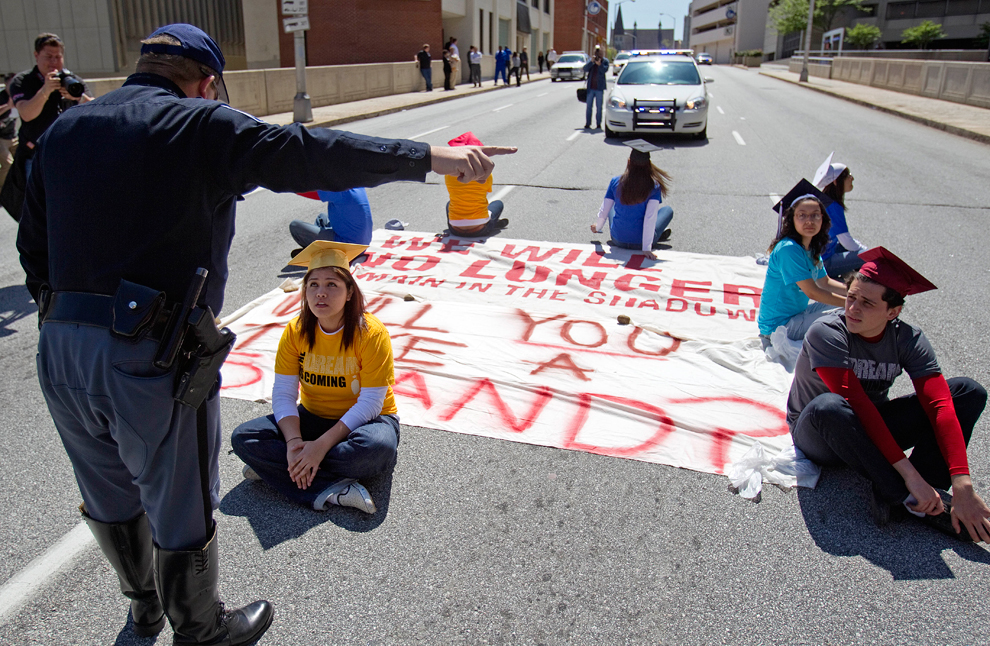
While there were a few well-meaning efforts to address immigration reform in the House and Senate under Democratic leadership, no progress was made. Outside Washington, DC, between President Obama's first day in office and the end of June 2011, one million immigrants and families have been detained, deported, or fired from their place of work. In addition, the well-oiled enforcement machine led by ICE in collaboration with local police departments under the rubric of the wrongly-named "Secure Communities," I-9 audits, and 287(g) agreements, just to name a few, is running full speed ahead.
Understandably, when the president argued once again at this year's NCLR conference that he is unable to do much on his own unless Republicans acquiesce and change our broken immigration laws, the chorus of "yes, you can" politely and in crescendo interrupted him.
During his speech, President Obama went to great pains to remind listeners that his administration is "keeping our promises." The audience must have nodded that when it came to the economy, gay and lesbian rights, and women's issues, the president has indeed delivered. But when President Obama pivoted to immigration reform, he blamed Republicans for the impasse, chided those who call on him to use his executive authority to alleviate the suffering of immigrant families, and committed to keep up the fight while encouraging the community to "keep the heat on me and Democrats." Lastly the Pied Piper in Chief, dressed in a most charming outfit, conceded he knows "very well the real pain and heartbreak that deportations cause" and he made an appeal we have heard once before: "Let's be honest. I need a dance partner, and the floor's empty."
It must not be an easy for President Obama to be at a party and not have a partner he can enjoy the music with. Although his political advisors are telling the president he has Latinos in the bag in 2012, the jury is by far out deliberating whether or not this president means it when he says he will fight the fight with us on the moral and practical issue of immigration reform. Does he meant it when he says we will not be stepped upon again? Thousands and thousands, millions even, of families throughout the United States are suffering on a daily basis the failure of this administration and this Congress to update our immigration laws. In the absence of real reform, immigrant communities everywhere have endured two and a half years of sustained torture led by none other than another "friend" of the community, Secretary Janet Napolitano, and face an increasing chorus of legislatures approving anti-immigrant, discriminatory, and unconstitutional laws. This song's tune is not for dancing.
Thus, the president must have surely felt the heat even while he read his speech at the NCLR conference. If he did, he kept his composure and was as eloquent and convincing as he was in 2008. But President Obama, Republicans and Democrats should recognize that we have danced together quite a lot during the past two years and a half and our feet are getting tired. Not tired enough to stop our fight for justice and changes in immigration laws so that they accurately reflect our nation's compassion, values, and interest. Not tired enough not to register millions more and switch the tune at the ballot box if this one does not suit us. Certainly we are not tired enough to remind our national elected leaders that even the most avid dancer can trip if he is not careful.


 Raul’s family has lived in Texas for 4 generations. He is a US Citizen. Six years ago he married Maria, whose parents brought her to the US illegally when she was a teenager. Raul and Maria now have two boys and are expecting another in three months. Raul works hard and pays all this taxes and mortgage on their home. Maria confides in you that she is an illegal alien and that her boss is paying her under the table so she can save on her payroll expenses.


Lately, though, there’s been a distinctly surreal flavour to Ms Taylor’s colourful display of patriotic identity. About 350 metres from her porch, an imposing metal fence looms into view. It is supposed to divide the US from Mexico, but by a cruel twist of fate, the 83-year-old grandmother’s family home has ended up on the “wrong” side. Four years ago, amid the seemingly endless hand-wringing over the flow of drugs and illegal migrants across their southern border, Washington politicians voted to erect a tall fence that would stretch thousands of miles from San Diego, on the Pacific coast, to Brownsville, on the Gulf of Mexico. The best-laid political schemes do not always work out as planned, though. When government engineers arrived in Ms Taylor’s neighbourhood, their plan hit a snag: the Mexican border follows the meandering Rio Grande in this area. And the river’s muddy banks are too soft and too prone to flooding to support a fence.
As a result, this corner of south-eastern Texas had its barrier constructed on a levee that follows a straight line from half a mile to two miles north of the river, leaving Ms Taylor’s bungalow – along with the homes and land of dozens of her angry neighbours – marooned on the Mexican side.


PHOENIX — The Supreme Court on Thursday upheld an Arizona law that penalizes businesses for hiring workers in the country illegally, buoying the hopes of supporters of state crackdowns on illegal immigration.
They predicted the ruling would lead to many other states passing laws that require employers to use the federal E-Verify system to check that workers aren't illegal immigrants. And some said the ruling bodes well for the prospects of a much broader and more controversial immigration law in Arizona, known as SB1070, to be found constitutional.
The state is appealing a ruling blocking portions of that law from taking effect.
But some legal experts said the ruling should not be read as a broad validation of such tactics. While they acknowledge that other states will now pass similar employer sanctions, they cautioned that the court did not make any sweeping endorsement of states' rights to enforce federal immigration laws.
See more of this and other articles on : The Huffington Post